AI-Generated Bios That Match Your AI Photos: 2025 Guide

You spent hours getting your AI dating photos perfect – they look natural, professional, and authentic. Then you slap on a generic bio that sounds nothing like the person in those photos. Instant red flag.
Here's the truth: your bio and photos tell a story together. When they don't match, people notice. A gym photo with a bio about Netflix marathons? A professional suit shot with casual slang? These disconnects cost you matches.
In 2025, dating app algorithms are smarter than ever. They analyze how your entire profile works together – photos, bio, prompts, everything. And users? They're trained to spot inconsistencies faster than you can say "catfish."
This guide shows you exactly how to create AI-generated bios that complement your AI photos, maintain authentic consistency, and actually improve your match rate. No generic templates. No obvious AI writing. Just profiles that work.
Key Takeaways
- Consistency is everything: Your bio must reflect the lifestyle, personality, and vibe shown in your AI photos – mismatches trigger instant skepticism
- AI bios need humanization: Raw AI-generated text sounds generic and robotic; add personal details, humor, and natural language to make it authentic
- Match the energy level: Professional AI photos need polished bios, casual photos need relaxed language – your writing style should mirror your visual presentation
- Test and optimize: Use A/B testing with different bio styles to see what performs best with your specific AI photo set
Why Bio-Photo Consistency Matters
Your dating profile is a package deal. When someone swipes through your photos and then reads your bio, their brain is constantly checking: does this add up?
Think about it like this – if your AI photos show you hiking mountains, dressed in outdoor gear, with natural lighting and adventure vibes, but your bio says "I'm a homebody who loves staying in and watching reality TV," something feels off. Not necessarily wrong, but inconsistent enough to make people pause.
The data backs this up. Dating app algorithms in 2025 use machine learning to detect profile coherence. They look at:

- Visual themes in your photos (settings, clothing, activities)
- Language patterns in your bio and prompts
- How well text content matches visual content
- User engagement patterns with cohesive vs inconsistent profiles
Profiles with strong bio-photo alignment get shown to more people. It's that simple. The algorithm assumes if your profile is coherent, you're more likely to get matches, which means more engagement, which is what apps want.
But beyond algorithms, there's basic human psychology. When your photos and bio tell the same story, you come across as genuine. When they contradict each other, you seem either confused about who you are or deliberately misleading. Neither helps you get dates.
Check Your Photos Before Matching Your Bio
Use our free AI Realness Score Analyzer to verify your photos look authentic before writing your bio. A cohesive profile starts with natural-looking photos.
Free analysis • Instant results • No signup required
Analyze Your Photos Free →Understanding Your AI Photo Vibe
Before you write a single word of your bio, you need to understand what story your AI photos are already telling. This isn't about what you told the AI to generate – it's about what the final photos actually communicate.
Pull up your AI photo set and answer these questions honestly:
What's the overall mood? Are they professional and polished? Casual and relaxed? Adventurous and outdoorsy? Artistic and creative? Your bio needs to match this energy level. If you have professionally generated AI photos with studio lighting and clean backgrounds, your bio should sound more refined. Casual selfie-style AI photos pair better with laid-back, conversational language.
What activities or settings appear most? If your AI photos show you in coffee shops, your bio mentioning you're a coffee enthusiast makes sense. Photos of you in suits? Reference your professional life. The settings in your photos should match the interests in your bio.
What's your apparent lifestyle? Do your photos suggest someone who's always out and about, or someone who enjoys quieter pursuits? Someone fitness-focused or food-focused? Your bio should reflect the lifestyle your photos portray – not necessarily your real lifestyle 100%, but close enough that it feels authentic.
What personality do the photos project? Smiling, approachable photos need warm, friendly bios. More serious, intense photos can handle edgier or more direct language. Artistic photos pair well with creative, thoughtful writing.
Here's a practical example. Say your AI photo set includes:
- A coffee shop photo with natural lighting
- A bookstore photo looking contemplative
- A casual outdoor photo in a city park
- A relaxed home photo with good lighting
This set reads as "thoughtful creative type who appreciates simple pleasures." Your bio should lean into that – maybe mention favorite books, local coffee spots, or enjoying city walks. What wouldn't work? A bio about extreme sports, clubbing, or corporate ambition. Not because those things are bad, but because they don't match the visual story.
Common Bio-Photo Mismatches to Avoid
Let's talk about the mistakes that make people instantly skeptical of your profile. These are the red flags that signal "this person used AI for everything and didn't think it through."
The Lifestyle Contradiction: Your AI photos show you in formal wear at nice restaurants, but your bio says you're "always down for street food and dive bars." Pick a lane. You can show range, but the primary vibe needs to match.
The Energy Mismatch: Photos are all high-energy – gym shots, adventure photos, action poses. Bio is super chill and talks about loving quiet nights in. People will wonder which version is real.
The Vocabulary Gap: Your photos look professional and polished, but your bio is full of slang and casual language that doesn't match the presentation level. Or vice versa – overly formal bio with casual photos.
The Interest Conflict: Photos suggest an outdoorsy personality (hiking, camping, nature shots) but your bio only mentions indoor activities (gaming, movies, cooking). You can like both, but there should be overlap.
The Age Inconsistency: This is subtle but important. If your AI photos made you look younger or older than you are, your bio's references and energy should roughly match. Mentioning things that date you differently than your photos appear will create confusion.
The Location Disconnect: Your AI photos might have generic backgrounds, but if your bio references specific local places that don't match the apparent setting in your photos, it raises questions.
The fix for all of these? Audit your photos first, understand what they're saying about you, then write your bio to complement that message. If you realize your AI-generated photos don't match who you actually are or want to present, generate new photos rather than trying to force your bio to bridge an impossible gap.
How to Generate Matching AI Bios
Now for the practical part – actually creating bios that work with your photos. Here's the step-by-step process that works.
Step 1: Analyze your photo set systematically
Don't just glance at your photos. Open them all and make notes:
- List every activity or setting shown
- Note the overall style (casual/formal, indoor/outdoor, social/solo)
- Identify the dominant personality traits they suggest
- Rate the energy level (1-10 scale, where 1 is super chill and 10 is high-energy)
Step 2: Create a bio prompt that matches
If you're using AI to help write your bio (most people do in 2025), your prompt needs to be specific. Generic prompts create generic bios. Try this format:
"Write a dating bio for someone whose photos show [describe your photos specifically]. The tone should be [match the energy you identified]. Include references to [activities shown in photos] and suggest a personality that's [traits your photos project]. Keep it under 150 words and make it sound natural, not AI-generated."
Step 3: Generate multiple versions
Don't settle for the first bio an AI spits out. Generate 5-10 different versions with slightly different prompts. Some will be too formal, some too casual, some too generic. You're looking for the sweet spot that matches your photos while still sounding like a real person wrote it.
Step 4: Humanize the AI output
This part matters. Raw AI bios sound robotic. They use certain phrases that are dead giveaways ("I'm passionate about," "I enjoy," "seeking someone who," "don't hesitate to"). Replace these with more natural language:
- Instead of "I'm passionate about coffee," try "I've tried every coffee shop in a 5-mile radius"
- Instead of "I enjoy hiking," try "I can't resist a good trail on weekends"
- Instead of "seeking someone adventurous," try "Looking for someone to explore new spots with"
Step 5: Add specific details
AI bios are often vague. Make yours specific to increase authenticity:
- Don't say "I love music" – name a genre or artist
- Don't say "I'm into fitness" – mention what you actually do
- Don't say "I like good food" – reference a cuisine or dish
These specifics should still match your photos. If your photos don't show anything music-related, maybe don't make that your primary interest in your bio.
Step 6: Test the read-aloud test

Read your bio out loud. Does it sound like something you'd actually say to someone? If it sounds like a LinkedIn summary or a college essay, rewrite it. Your bio should sound conversational, like you're telling a friend about yourself at a bar.
Create a Complete Profile That Gets Matches
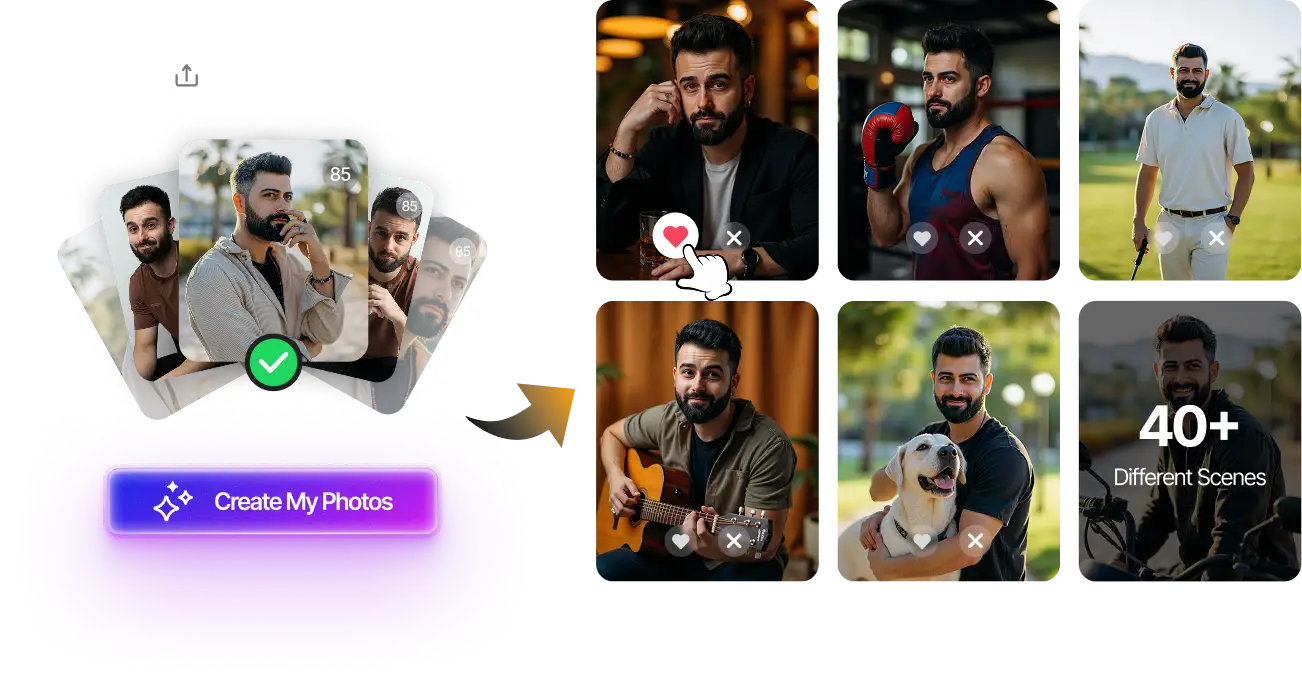
Upload your selfies and get 80-180 AI-optimized dating photos in 20 minutes. Then use our bio optimization tips to create a cohesive profile that actually works.
100+ unique photos • Privacy-first • One-time payment
Get Started Now →Bio Templates for Different Photo Styles
Your AI photo style should dictate your bio approach. Here are proven templates for the most common styles.
Professional/Polished Photos (suits, clean backgrounds, studio-style lighting):
Your bio should be confident and put-together, but not stuffy. Example structure:
"[Career/what you do] by day, [hobby that shows personality] when I'm not [work reference]. I have strong opinions about [something light, like coffee or pizza] and I'm always looking for [next adventure/experience/thing to try]. Looking to meet someone who [quality that matters to you] and doesn't take life too seriously."
Casual/Lifestyle Photos (coffee shops, everyday settings, natural poses):
Go conversational and relaxed. Example structure:
"You'll usually find me [activity from photos] or [another activity from photos]. I'm into [interest 1], [interest 2], and finding the best [local thing – tacos, bookstores, whatever]. Pretty low-key but always down to [suggestion that matches your photos]. Let's [date idea that fits your vibe]."
Outdoor/Active Photos (hiking, sports, adventure shots):
Show energy and enthusiasm, but don't be overwhelming. Example structure:
"Weekends are for [outdoor activity]. Recently [specific achievement or experience]. Also enjoy [indoor balance activity] to balance it out. Looking for someone who [activity-related quality] and isn't afraid of [small challenge related to your interests]."
Creative/Artistic Photos (interesting angles, artistic settings, unique style):
You have more room to play with language here. Example structure:
"[Unusual fact about yourself]. I spend too much time [creative pursuit] and not enough time [humorous admission]. Currently obsessed with [specific interest]. Hoping to find someone equally weird who [quality] and wants to [activity]."
Notice what these templates don't do: they don't use clichés, they don't sound like AI wrote them, and they all leave room for your specific personality to come through. The goal is coherence with your photos while maintaining authenticity.
Fine-Tuning Language and Tone
The difference between a bio that works and one that doesn't often comes down to small language choices. Here's what tone matching looks like in practice.
If your photos are formal or professional:
- Use complete sentences (but keep them conversational)
- Avoid heavy slang or text-speak
- You can use humor, but make it sophisticated
- Reference activities that require some planning (nice restaurants, cultural events)
- Your confidence should come through in your word choices
If your photos are casual and relaxed:
- Shorter sentences are fine
- You can use more casual language ("I'm" instead of "I am")
- Humor can be more laid-back and relatable
- Reference everyday activities that feel accessible
- Your vibe should be approachable and easy-going
If your photos show you're active/outdoorsy:
- Use action words (exploring, discovering, trying)
- Energy should be present but not overwhelming
- Show you have range (balance outdoor stuff with indoor interests)
- Specifics matter here – name the trail, the sport, the activity
If your photos are artistic or creative:
- You have the most freedom with language
- Can be more playful with structure and style
- Show personality through unexpected word choices
- But don't be so unique that you're confusing
Here's a practical example of tone matching. Say you have coffee shop photos with natural lighting – the "thoughtful creative" vibe we discussed earlier.
❌ Tone mismatch: "High-energy professional seeking adventure! Love extreme sports and always on the go. Looking for someone to keep up with my intense lifestyle!"
✅ Tone match: "Usually found with a book and good coffee. I appreciate slow mornings and deep conversations. Looking for someone who values thoughtfulness over constant activity."
Both could be true about you, but only one matches the photos. And if you really are that high-energy person, you need different photos.
Testing and Optimization
Here's something most people don't do: they write one bio, post it, and never change it. That's a mistake. Your bio is a variable you can test.
Set up A/B tests:
Most dating apps won't let you run formal A/B tests, but you can approximate it. Write 2-3 different bio versions that all match your photos but have different angles. Rotate them weekly and track your match rate.
For example, if you have professional photos, you might test:
- Version A: Career-focused with work achievements
- Version B: Career mentioned but personality-focused
- Version C: Minimal career talk, mostly hobbies
All three match your photos, but emphasize different aspects. See which performs best.
Track your metrics:
Keep a simple spreadsheet:
- Which bio version
- Date range it was active
- Number of matches
- Quality of conversations (subjective but important)
- Any patterns in who matched with which version
Get feedback (carefully):
Ask a couple trusted friends to review your bio-photo combination. Be specific: "Does this bio match the vibe of these photos?" Not just "Is this bio good?" You're testing coherence, not whether they like your interests.
Watch for conversation patterns:
When people message you, what do they reference? If everyone mentions something from your photos but nobody mentions your bio, your bio might not be adding value. If people seem confused or ask questions that your bio should answer, there's a disconnect.
Check your Realness Score correlation:
If you used our Realness Score Analyzer for your photos, note that score. Then track if different bio styles affect your match rate while keeping the same photos. Sometimes a more natural-sounding bio can compensate for slightly lower-scoring photos by reducing overall profile skepticism.
Seasonal adjustments:
Your bio might need tweaks based on season. If you have seasonal AI dating photos, your bio should adjust too. Summer photos with outdoor settings pair better with mentions of outdoor activities. Winter photos with cozy settings can support more indoor-focused bio content.
Red Flags That Kill Credibility
Even if your bio matches your photos, certain phrases or approaches will tank your credibility. Here's what to avoid.
AI writing tells:
These phrases give away that AI wrote your bio without human editing:
- "I'm passionate about" (overused, sounds corporate)
- "seeking someone who" (too formal, sounds like a job posting)
- "don't hesitate to" (nobody talks like this)
- "I enjoy" (weak verb, sounds generic)
- "equally passionate" (AI loves this phrase)
- "looking for my partner in crime" (so cliché AI suggests it constantly)
Over-explanation:
If your bio needs to explain why your photos look a certain way, something's wrong. "These are AI photos but I really look like this" or "I used AI for better quality" – just don't. Your photos and bio should stand on their own without disclaimers.
Contradictory signals:
"I'm an introvert who loves huge parties." "I'm super spontaneous but need everything planned out." "I'm laid-back but also super competitive about everything." Pick a primary trait and stick with it. Complexity is fine, but contradiction is confusing.
Generic compliment-fishing:
"Ask me about my photos" or "Swipe right to find out more about these pics" – this draws attention to potential AI usage and sounds desperate.
Mismatch in sophistication:
If your photos look professionally done (whether AI or real), your bio can't sound like a teenager wrote it. And if your photos are casual and fun, your bio can't read like a LinkedIn profile. Match the sophistication level.
Related guide: For a more focused next step, read How to Write a Bio That Explains Your AI Photos and connect this advice to your wider dating profile plan.
Final Thoughts
Creating AI bios that match your AI photos isn't about deception – it's about coherence. Your dating profile is your personal brand, and like any good brand, every element should support the same core message.
The best profiles in 2025 are those where photos and bio work together to tell a clear, consistent story about who you are and what you're looking for. When someone can look at your photos and read your bio and think "yeah, this all tracks," you've done it right.
Start with your photos, understand what story they tell, then write a bio that continues that narrative naturally. Test different versions, track what works, and refine based on results. Consistency doesn't mean boring. It means authentic.
Ready to build a profile that works? Start by getting your photos right with our AI dating photo generator, then use the strategies in this guide to craft a bio that matches. Your future matches are waiting.
Build Your Complete Dating Profile
Get 80-180 professional AI photos that tell your story, then use our optimization tips to create a bio that matches your visual brand.
Complete profile solution • Privacy-first • 100+ photos
Start Your Profile Now →FAQ
Should I mention using AI photos in my bio?
No. Your profile should stand on its own without disclaimers. If your AI photos look natural and your bio matches them, there's no need to explain your process. Focus on presenting yourself authentically rather than defending your methods.
Can I use completely AI-generated bios without editing?
Raw AI-generated bios almost always need humanization. They tend to use generic phrases, formal language, and obvious patterns that make them feel inauthentic. Always edit AI-generated bios to add specific details, adjust tone, and remove common AI tells.
How do I match my bio to photos if my real personality differs from what the photos show?
This is a sign you need different photos, not a different bio. Your profile should represent who you actually are. If your photos project a personality that doesn't match yours, regenerate them with different prompts that better reflect your real interests and lifestyle.
What if I have a mix of AI and real photos?
Your bio should match the overall vibe of your complete photo set, not individual photos. Look at your profile as a whole – what's the dominant style, energy level, and personality shown across all photos? Write your bio to match that overall impression.
How often should I update my bio to keep it matching my photos?
Test new bio versions every 2-3 weeks to optimize performance. Update immediately if you change your photo set, since new photos might project a different vibe. Small seasonal tweaks can help keep your profile fresh and relevant.