Rate My Tinder Profile: How the Scoring Works and What to Fix First
Introduction
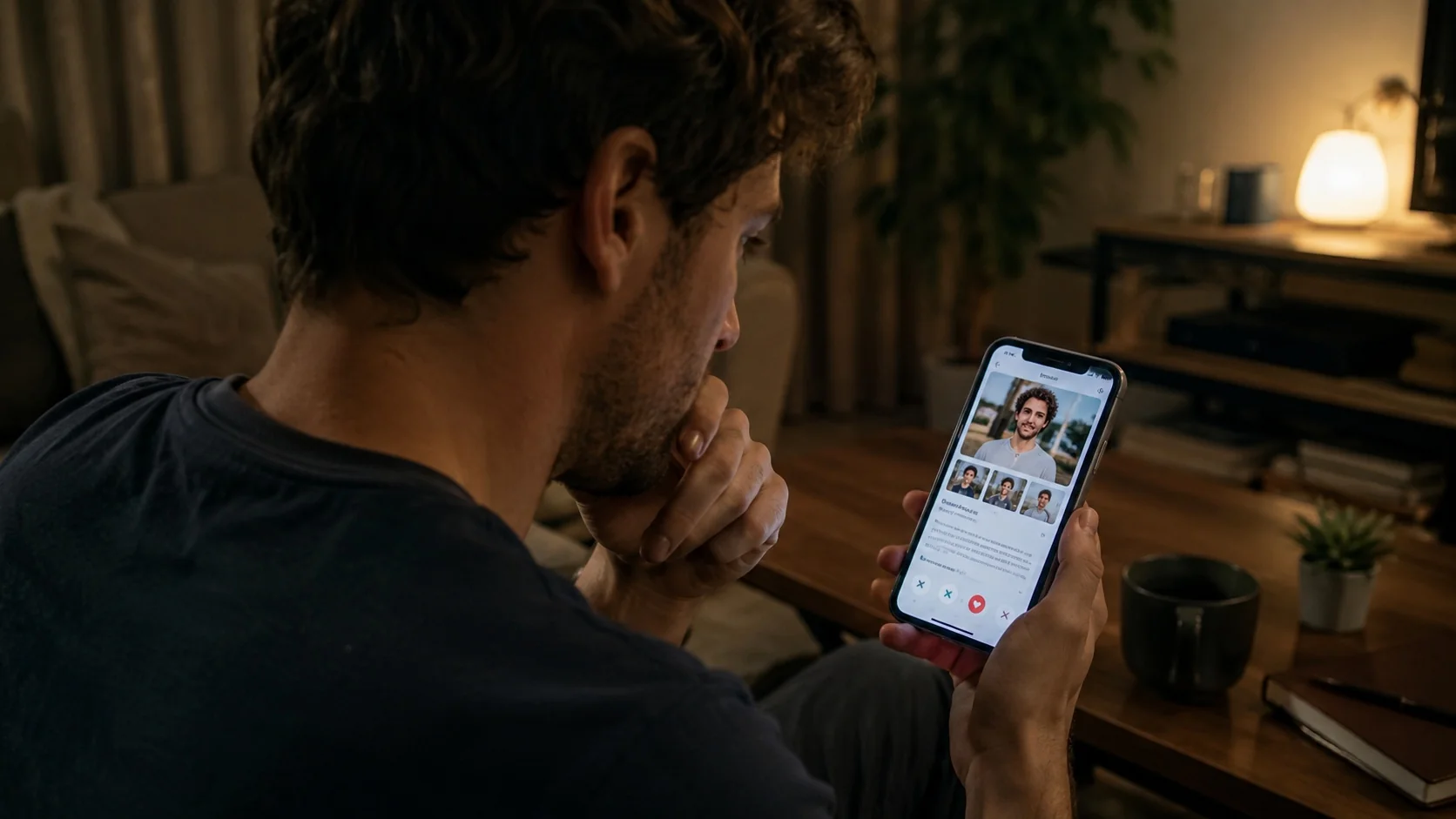
When you type "rate my Tinder profile" into Google or drop your screenshots into a Reddit thread, you're really asking one question: what is losing me matches, and in what order should I fix it? The short answer is that almost every rating system, human or AI, scores the same four things: your first photo, the variety across your photo lineup, whether your face is actually visible and readable, and whether your bio gives someone a reason to reply. Everything else is noise.
The problem with crowdsourced ratings is that you get a number without a repair order. Ten strangers give you a 5/10 and eleven contradictory suggestions. You change your bio, keep the same weak lead photo, and nothing moves.
This guide covers what feedback threads consistently get right, where AI scoring and human scoring diverge, and the exact sequence to fix things after a low score. There's also a section on the rate my Hinge profile variant, because the scoring criteria are not the same.
Key Takeaways
- Your first photo carries most of the score. In swipe-based rating, people decide before they read anything. If photo one is weak, no bio rewrite saves the profile.
- Human raters are great at gut reactions, bad at diagnosis. They can tell you something feels off. They usually can't tell you which variable caused it.
- AI scoring is consistent, not intuitive. It reliably flags technical issues like resolution, framing, face clarity, and redundancy, but it won't catch social signals like a cringe caption or a red-flag group shot.
- Fix in order: lead photo, lineup variety, face clarity, bio, then prompts and extras. Working backwards is why most people see no improvement.
- Hinge scoring weights text far more heavily than Tinder. Same photos, different grade.
What "Rate My Tinder Profile" Actually Measures
Whether the rating comes from a subreddit, a friend, or a scoring tool, it collapses into a handful of judgments made in a few seconds.
Your Tinder profile is a short stack: photos first, then a bio and a few optional fields. That structure means raters spend most of their attention on images and treat text as a tiebreaker. So when someone says "6/10," they're usually reacting to your photo set and rationalizing the number afterward.
Here's what a rating is really scoring, and how much weight each element carries in practice:
| Element | Approximate weight | What raters react to |
|---|---|---|
| First photo | Very high | Face clarity, expression, lighting, crop |
| Photos 2-4 | High | Variety, body shot, social proof, activity |
| Photos 5-6 | Low to medium | Whether they add anything or repeat |
| Bio | Medium | Effort, humor, reply hooks, red flags |
| Extras (job, height, prompts) | Low | Consistency and completeness |
The takeaway: if you want your score to move, you have to move the heavy items. A clever bio line cannot outrank a dim, cropped-from-a-group lead photo.
Why People Post in Reddit Rate-Me Threads
Subreddits like r/RateMyTinder sit near the top of search results for this query, and there's a real reason for that. They're free, fast, and brutally honest in a way friends aren't. If you post there, you'll usually get replies within an hour.
But the format has structural limits. Feedback threads reward whoever comments first, most confidently. Advice is anecdotal, based on one person's taste, and frequently contradicts the next comment. You'll see the same recurring feedback patterns, which are worth knowing before you post:
- "Your first pic is a group shot": the single most common complaint, and the most legitimate one.
- "Sunglasses/hat in every photo": raters read hidden faces as hiding something.
- "All the same angle": six near-identical selfies read as having only one photo.
- "No full-body shot": absence gets interpreted, usually unkindly.
- "Your bio is just a list": height, city, zodiac, done. Nothing to reply to.
- "Bathroom mirror pic": the setting overrides whatever you look like in it.
Notice something: five of those six are photo problems. Notice something else: none of them tell you what to shoot instead. That's the gap. A rating tells you where you stand, but it doesn't hand you a plan. If you want a structured version of the same critique before you go public with your screenshots, run through a 15-point dating profile self-audit first. It catches most of what strangers would flag anyway.
One more caution about public rate-me threads: you're posting your face, your first name, and often your city to a permanent, searchable archive. If you'd rather not do that, a private review gets you the same diagnostic without the exposure.
Check Your Photos Before Tinder Does
Use our free AI Realness Score Analyzer to check if your photos might trigger detection systems.
Free analysis • Instant results • No signup required
Analyze Your Photos Free →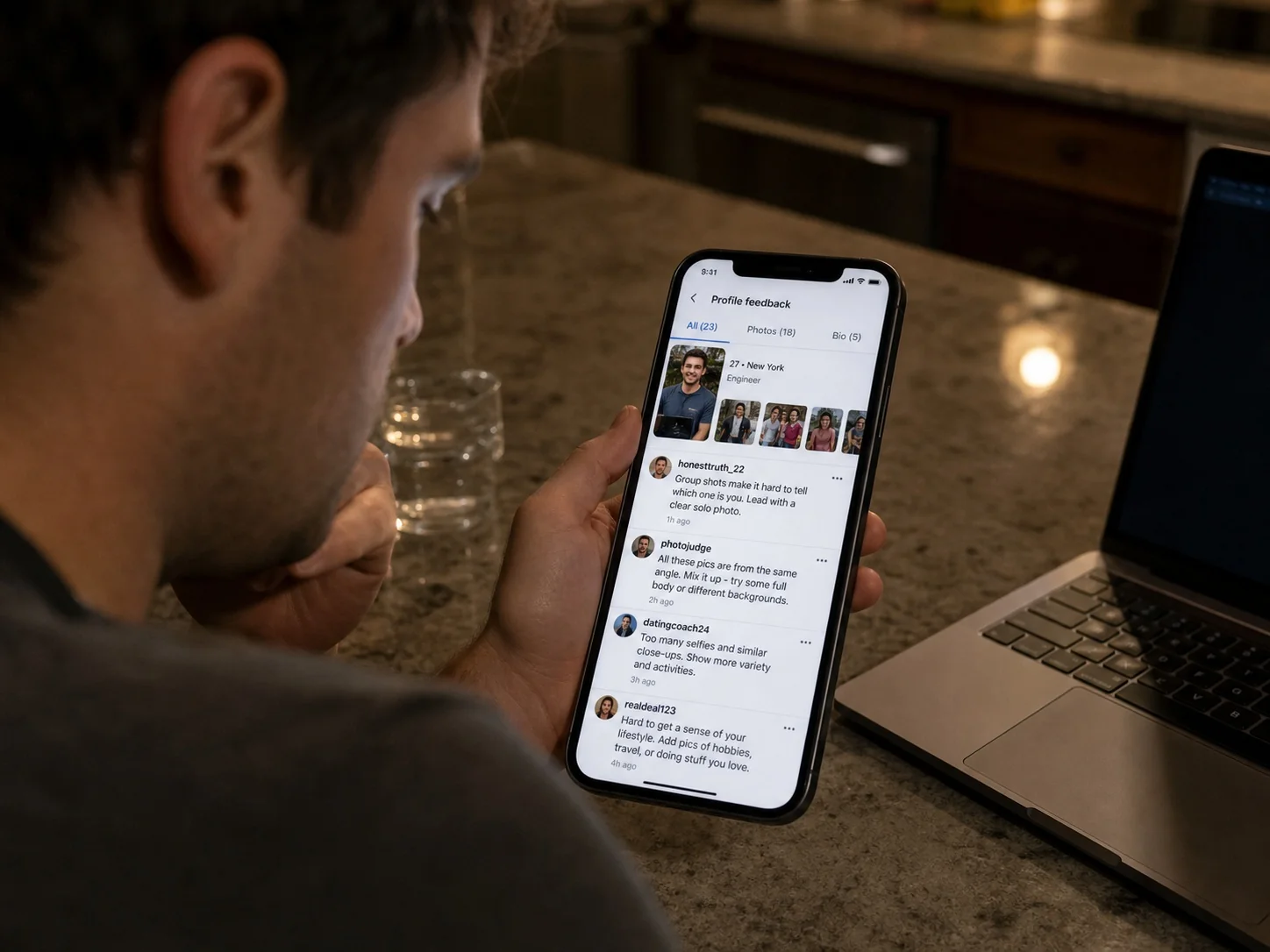
AI Scoring vs Human Scoring: Where They Agree and Differ
People often assume an AI profile score and a human rating are competing answers to the same question. They're not. They measure different layers, and knowing which one to trust for which problem saves you a lot of wasted editing.
Where they agree: both reliably punish poor face visibility, low-resolution or heavily compressed images, repetitive photo sets, and missing variety. If a tool and a stranger both say your lineup is monotonous, that's not opinion. That's a real defect.
Where they diverge: AI is consistent but literal. Humans are intuitive but inconsistent.
| Dimension | AI scoring | Human rating (Reddit, friends) |
|---|---|---|
| Consistency | Same input, same score every time | Varies by rater, mood, and thread |
| Technical quality | Strong: resolution, blur, crop, lighting | Weak unless it's obvious |
| Lineup redundancy | Strong: detects near-duplicate shots | Moderate, usually noticed |
| Social signals | Weak, misses cringe, context, subtext | Strong: this is what humans are for |
| Bio voice and humor | Moderate, can flag effort but not charm | Strong |
| Prioritization | Strong: ranks issues by impact | Weak, everything sounds equally urgent |
| Bias | Systematic, predictable | Personal, unpredictable |
The practical rule: use AI or a structured tool to find and rank the defects, then use a human to sanity-check tone. Run a structured dating profile review to get the ordered defect list, then ask one person you trust whether anything reads badly socially. That combination beats either method alone.
What neither can do is guarantee outcomes. A 9/10 profile in a small town with a thin dating pool still gets fewer matches than a 6/10 in a dense city. Scores measure your profile, not your market.
What to Fix First After a Low Score

This is the part rating threads never give you. Fix in this order, and re-evaluate after each step instead of changing everything at once. Otherwise you won't know what worked.
Step 1: Replace the lead photo
One person, face clearly visible, eyes visible, shot from roughly chest-up to waist-up, natural light, genuine expression. No sunglasses, no hat brim shadowing your eyes, no group. If you only change one thing, change this. Everything downstream depends on someone stopping here.
Step 2: Fix lineup variety
Four to six photos, each doing a different job: the clear lead portrait, one full-body, one activity or hobby shot, one social shot with a friend or two, and optionally one candid. Delete anything that duplicates a job already covered. Six versions of the same angle counts as one photo. Our breakdown of what actually gets right swipes on Tinder maps which shot types earn their slot.
Step 3: Fix face clarity across the set
Go photo by photo: can a stranger identify you in each one? If your face is small, blurred, backlit, or obscured in half your lineup, you're asking people to guess what you look like. Guessing usually resolves downward.
Step 4: Rewrite the bio for one reply hook
Cut the list of stats. Give one specific, easy-to-respond-to detail: a strong opinion, an ongoing project, a weird preference. "Currently ranking every taco truck within a 10-mile radius, ask me for the shortlist" outperforms "6'1\", love travel and dogs." You need one door someone can walk through.
Step 5: Sequence and extras
Only now does photo order matter. Put your second-strongest image at position two, not at the end. Fill in job, school, and any optional fields, since incomplete profiles read as low-effort or fake. If you're deciding where to place your best shots, the seven photo types that get more matches covers placement logic in detail.
What not to do first: don't buy boosts, don't delete and remake your account, and don't tweak your bio for the fifth time while the same weak lead photo sits in slot one. Those are all ways of avoiding the expensive fix.
Check Your Photos Before Tinder Does
Use our free AI Realness Score Analyzer to check if your photos might trigger detection systems.
Free analysis • Instant results • No signup required
Analyze Your Photos Free →"Rate My Hinge Profile": Different Scoring Rules
If you're searching rate my Hinge profile, expect a different grading curve. Hinge shows six photos and three prompt answers, and people interact by liking a specific element rather than swiping a whole card. That structure shifts weight toward text.
Hinge's own profile refresh guidance emphasizes photo variety and keeping prompts current and specific, which matches what raters penalize most: recycled generic prompt answers.
| Criterion | Tinder weighting | Hinge weighting |
|---|---|---|
| Lead photo | Dominant | Important but not decisive |
| Photo variety | High | High |
| Written content | Tiebreaker | Major: prompts drive likes |
| Specificity of details | Moderate | Very high |
| Profile completeness | Moderate | High |
Two practical implications. First, a photo set that scores fine on Tinder can score poorly on Hinge if your prompts are lazy. "Two truths and a lie" with no lie worth guessing is a wasted slot. Second, authenticity rules matter: Hinge's Community Guidelines require your profile to represent you accurately, so heavily altered images or someone else's photos are a compliance problem, not just a scoring one. For a Hinge-specific repair list, see our 10 Hinge profile fixes.
Common Mistakes to Avoid
Even people who get good feedback tend to sabotage it in the same predictable ways.
- Changing everything at once. New photos, new bio, new order, same day. Now you have no idea which change helped.
- Treating one stranger's taste as data. If a single commenter hates your hiking photo, that's a preference. If six do, that's a signal.
- Optimizing for raters instead of your actual audience. Feedback threads skew toward whoever is online at 2 a.m. They are not your local dating pool.
- Chasing a number. A profile score is a diagnostic instrument, not a scoreboard. Going from 6 to 7 means nothing if the 7 came from adding a filler photo.
- Over-editing to look better than you do in person. Heavy retouching creates a mismatch that gets discovered on the first date, and it conflicts with platform authenticity expectations.
- Ignoring the boring fixes. Cropping, brightening, and reordering existing photos often produce a bigger jump than any new shoot.
And one process mistake: don't re-post your profile for a new rating three days later. Give changes at least a week or two of normal usage before judging results.
Final Thoughts
Asking someone to rate my Tinder profile is a reasonable instinct, since you can't see your own profile the way a stranger does. But a number on its own doesn't fix anything. What changes outcomes is knowing that your lead photo carries most of the weight, that photo variety is the second-largest lever, and that bio edits belong near the end of the list rather than the beginning.
Use human feedback for tone and social read. Use structured or AI scoring for consistency and prioritization. Then work top-down through the fix order: lead photo, lineup variety, face clarity, bio, sequencing. Change one layer, give it time, and check whether the needle moved before touching the next one.
If you'd rather not post your face to a public thread to find out what's wrong, get the same diagnosis privately and skip straight to the repair order.
Transform Your Dating Profile Today
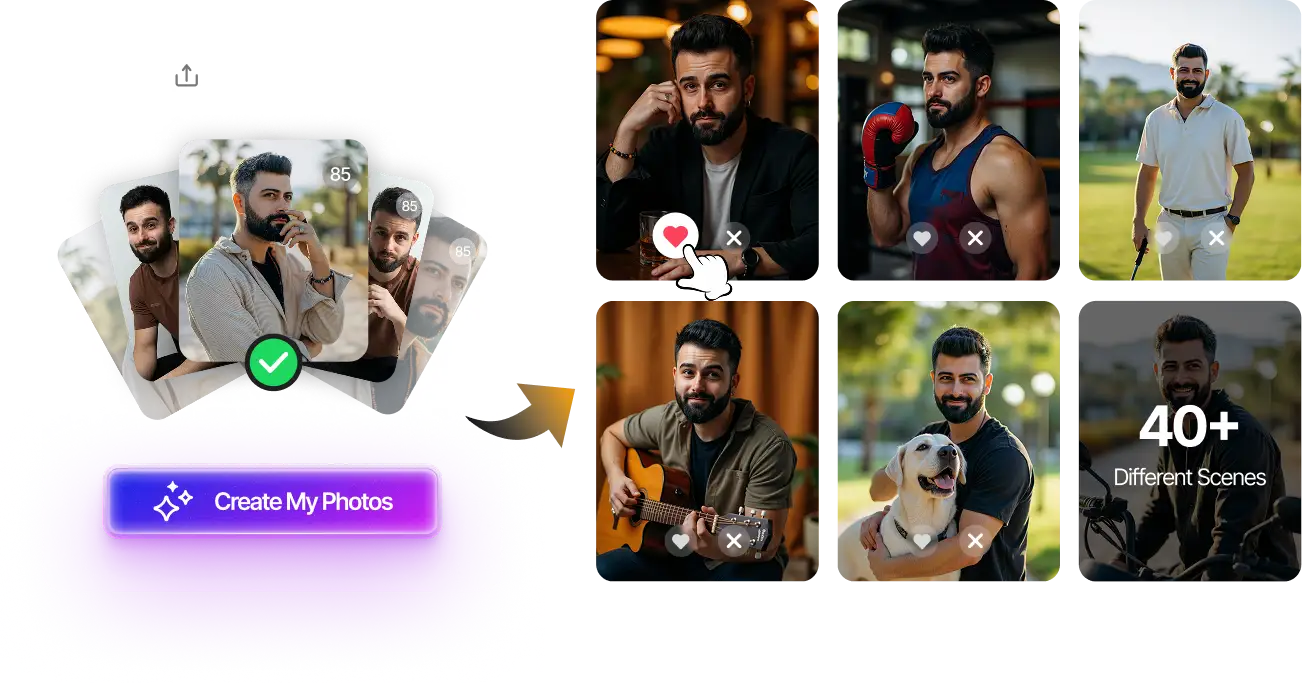
Upload your selfies, get 80-180 AI-optimized dating photos in just 20 minutes. No photoshoot needed.
7-Day Money Back • Privacy-first • One-time payment
Get Started Now →FAQ
Is posting on r/RateMyTinder actually worth it?
It's useful for one thing: catching social signals you're blind to, like a caption that reads badly or a photo that gives an unintended impression. It's poor at prioritizing fixes, and you're publishing your face and location to a permanent public archive. Weigh that trade-off.
Why did my profile score low when my photos look fine to me?
Usually redundancy or face clarity. Photos that look good individually can score poorly as a set if they're all the same angle, same lighting, or same setting. Raters judge the lineup, not each image in isolation.
How many photos should I have on Tinder?
Four to six, each covering a different job: clear portrait, full-body, activity, social. Adding a seventh photo that repeats an existing role usually lowers the average rather than raising the total.
Does a better score guarantee more matches?
No. Scoring measures your profile, not your market. Location density, age range, and how selectively you swipe all affect results independently of profile quality.
Should I rate my Hinge profile by the same standards as Tinder?
Not entirely. Hinge weights prompt answers and specific details much more heavily because people like individual profile elements rather than swiping a whole card. Strong photos with generic prompts underperform on Hinge more than on Tinder.